There is a long lived tale that Jerry Seinfeld became one of the greatest comics of all time due to his consistency. He was said to have written a joke every day, on days he felt like it but also on days he didn’t, and marked the days with a big red cross on his calendar.
This story has been debunked by Seinfeld himself in this Reddit thread.
This is hilarious to me, that somehow I am getting credit for making an X on a calendar with the Seinfeld productivity program. It’s the dumbest non-idea that was not mine, but somehow I’m getting credit for it.
Still, I found the idea of having a daily mark on a calendar to show me my post streak interesting enough to inspire my next experiment. Even though Seinfeld never actually did this, the underlying principle of marking a day on a calendar is turning a habit into something you can see. Whenever I use GitHub I always get a feeling of satisfaction seeing the green activity overview.
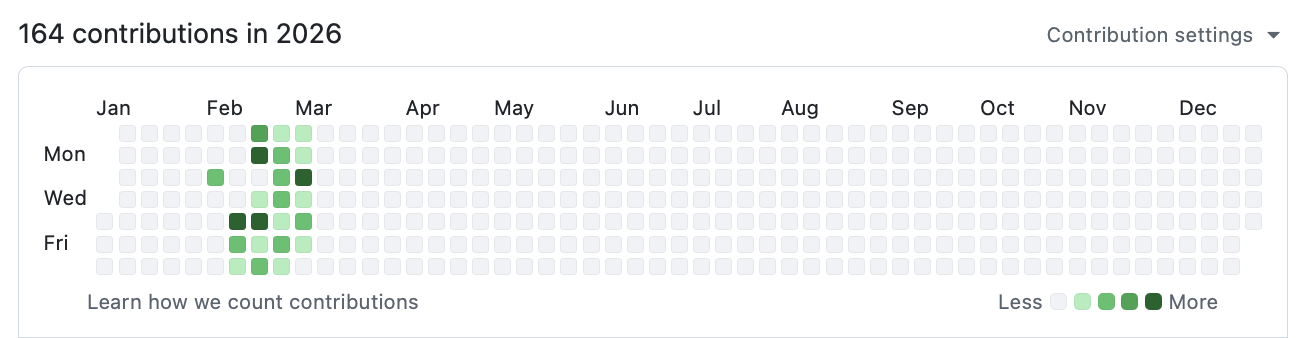
Could I build a GitHub-style activity view for my experiment posts? And could I do it in one shot? I value things built in a way that makes them modular and clean. After already adding custom discussion tooling to the site, I did not want another feature that only worked once and only here. And since this was self-contained enough to stand on its own, it felt like a natural candidate for publishing as an open source Hugo module (yes, same Hugo… I know it’s confusing 😆).
The actual process of creating the module was straightforward, as Codex helped me /plan it out in some detail. Codex asked me roughly 9 questions, things like how do we handle ‘draft’ posts or should cells be clickable. After that it started humming on building the feature.
I created a separate project folder in Codex so that I would have a separate git repository for it. This helped me compartmentalize the code as a Hugo module.
I was not surprised by this point that Codex could build this, and do it in one go. What did surprise me was that it referenced my other Codex project in which my actual website was created. This was great, it understood that the module needed to actually plug into my existing site. Being context-aware saved me quite a lot of time.
AI Experiment Activity in the Last Year
Key Insight: We Don’t Always Need the Truth to Find Something True
When I was writing about this experiment, I was planning to reference the Jerry Seinfeld story, but wasn’t aware it got debunked. My first instinct was to scrap the story, but then realized it could still be true for me. So the fact that a debunked story still brought forth a living, breathing feature on my website is what I learned.