I wanted to do a different experiment this time. Last week the Nano Banana 2 model from Google was released and I was intrigued. Can a modern image model reliably render long texts, especially when perspective and realism increase? Or does realism break typography?
For the experiment I thought it would be nice to have a piece of text from my website that is already published and have it displayed subtly inside the images. I would judge the model on text accuracy and scene realism.
I used ChatGPT to create a prompt for Nano Banana 2. For this experiment I used Freepik.com with a paid account so that I could run the same prompt through multiple different image models next to each other.
Prompt 1: Flyer on the Ground
Prompt
Prompt 1
Scene
Create a high resolution, ultra realistic photograph of a single A4 flyer lying on the ground outdoors.
Environment:
- Light concrete pavement or soft beige stone tiles
- Warm late afternoon golden hour light
- Soft long shadows
- Minimal surroundings with no clutter
- Subtle modern architectural background out of focus
The flyer is the clear focal point.
Flyer Design Style (hugomelis.nl)
- Minimalist layout
- Generous white space
- Clean grid structure
- Modern sans-serif typography similar to Geist style
- Black or very dark gray text
- No decorative illustrations
- Subtle typographic hierarchy with clear headline and body text
- Quiet, thoughtful, structured aesthetic
The flyer must feel like a carefully designed editorial piece, not a cheap printout.
Text Fidelity Requirements
The text on the flyer must be rendered perfectly and exactly as written below.
Do not rewrite, summarize, shorten, or modify any wording. Preserve exact spelling, punctuation, capitalization, and paragraph structure. Text must be fully legible and sharp.
Exact Flyer Text
My bot can order groceries now, we need that right?

I saw Mark post a message on X that he made a skill for OpenClaw that made it able to start ordering groceries from Albert Heijn in the Netherlands. I was immediately intrigued by this, as it needs to be done each week and is a huge cognitive load. Ordering groceries is the thing I loathe most, except maybe for having to go to the actual store.

But after reading about the most downloaded skill for OpenClaw being infected with malware I was hesitant to randomly install a shopping skill. I imagined loads of toilet paper being sent over because of malware. So I had ChatGPT inspect it first. I just asked if this skill contained any obvious malware. After it did a thorough inspection it told me this skill was ok. However there was another Go library (appie-go by @gwillem) that was called from within that needed further checks. So after also checking that library, ChatGPT deemed it all good. So I could have Henk install the skill without any security concerns.
Camera and Material Notes
- Camera angle: slightly angled top-down view
- Realistic lens compression with natural depth of field
- Paper should have subtle texture and realistic interaction with light
- The flyer should feel like a designed artifact that contrasts with the outdoor environment
- Focus of the image: accurate long-form text rendering in a real-world setting
Nano Banana 2 produced an image where the text was 100% identical and had all punctuation and almost all line breaks correct. However, the flyer looked unrealistic. It was extremely basic and static, not what I would have expected based on the prompt.
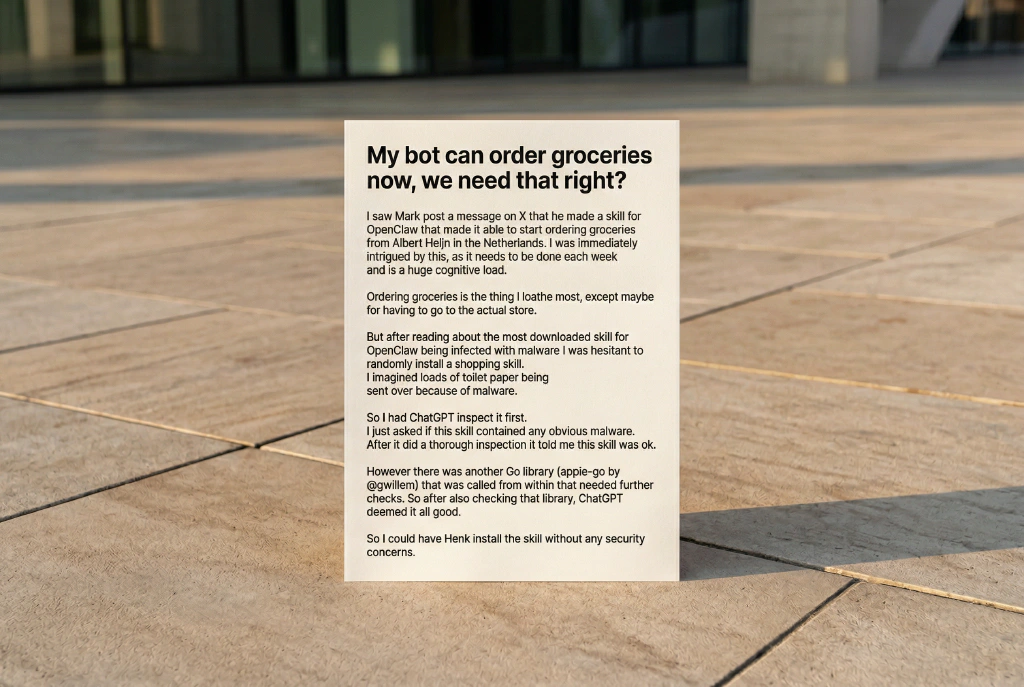
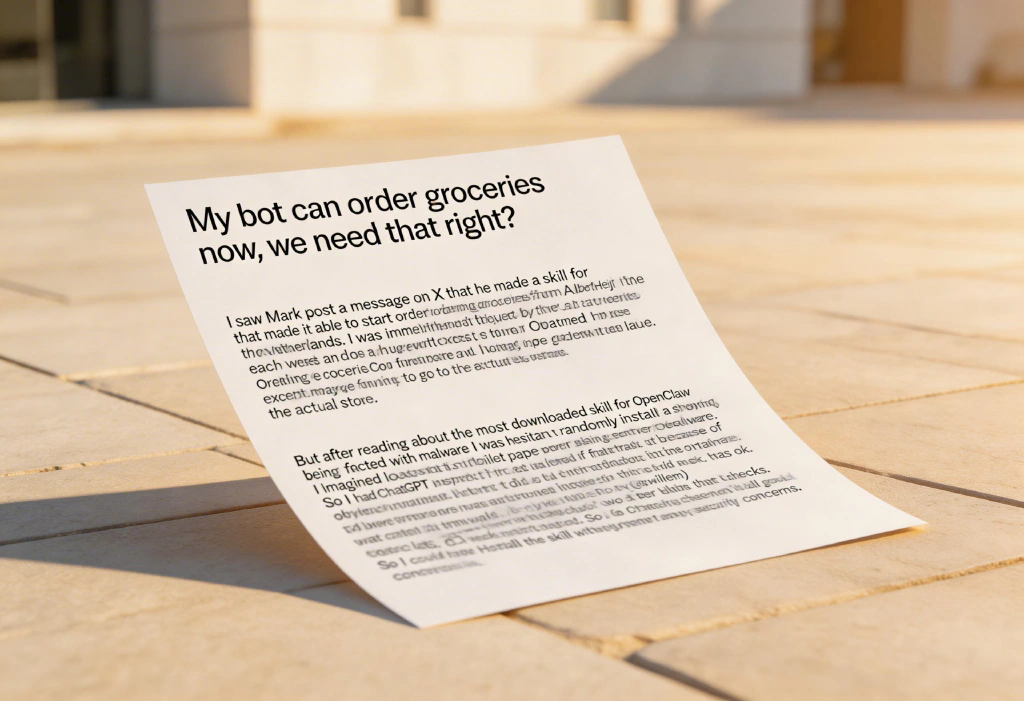
I then ran the same prompt with another image model, Seedream-5-lite, to compare it. This model was better at placing the flyer naturally on the ground. However, the text was heavily distorted. Most words were incorrect and characters were bleeding into each other. My assumption is that this is because the flyer is not straight, unlike the front-facing version produced by Nano Banana 2. I did not test a straight-on version with Seedream-5-lite, so this remains an assumption.
Prompt 2: Bus Stop Poster
Prompt
Prompt 2
Scene
Create an ultra realistic photograph of a modern Dutch bus stop with a glass shelter and a large vertical advertising panel in the style of a JCDecaux street poster.
Environment:
- Typical Dutch urban setting
- Clean pavement
- Subtle bicycle lane markings nearby
- Minimal modern architecture in the background
- Soft golden hour light with long shadows
- Slightly cinematic but realistic
Poster Design Style (hugomelis.nl)
The advertising panel must contain a professionally designed poster inspired by the visual identity of hugomelis.nl:
- Minimalist layout
- Generous white space
- Clean grid structure
- Modern sans-serif typography similar to Geist
- Black or very dark gray text on white background
- No stock imagery
- Editorial, thoughtful aesthetic
The first sentence must be a large, bold headline at the top of the poster. The remaining text must appear below it as well-structured body copy.
Text Fidelity Requirements
Text must be rendered exactly as written below. Do not summarize, rewrite, shorten, or paraphrase. Preserve exact spelling, punctuation, capitalization, and paragraph structure. The text must be sharp, fully legible, and correctly spaced.
Exact Poster Text
My bot can order groceries now, we need that right?

I saw Mark post a message on X that he made a skill for OpenClaw that made it able to start ordering groceries from Albert Heijn in the Netherlands. I was immediately intrigued by this, as it needs to be done each week and is a huge cognitive load. Ordering groceries is the thing I loathe most, except maybe for having to go to the actual store.

But after reading about the most downloaded skill for OpenClaw being infected with malware I was hesitant to randomly install a shopping skill. I imagined loads of toilet paper being sent over because of malware. So I had ChatGPT inspect it first. I just asked if this skill contained any obvious malware. After it did a thorough inspection it told me this skill was ok. However there was another Go library (appie-go by @gwillem) that was called from within that needed further checks. So after also checking that library, ChatGPT deemed it all good. So I could have Henk install the skill without any security concerns.
Camera and Material Notes
- Camera angle: eye-level, slightly off-center perspective
- Ensure realistic reflections in the bus stop glass
- Poster must look physically installed inside the advertising frame
- Focus of the image: accurate long-form text rendering in a real-world urban environment with clear typographic hierarchy
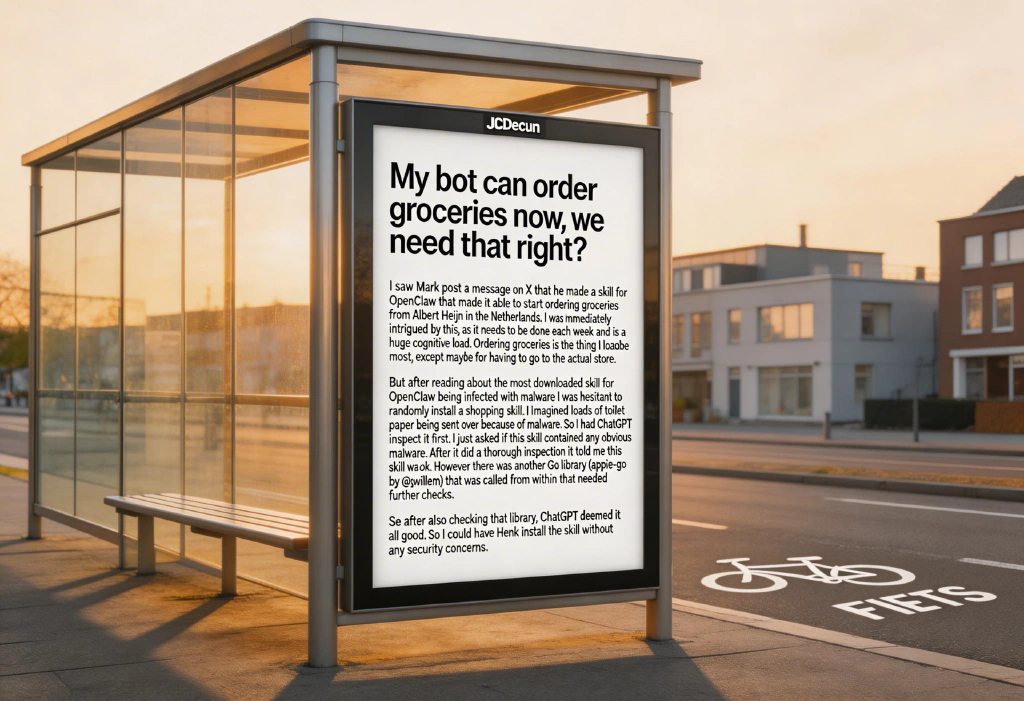
I then ran additional tests using a prompt that placed the text in a street setting with a bus stop. With Seedream-5-lite, the text accuracy was 100% and the scene realism was acceptable.
However, the name of the advertising company JCDecaux was spelled incorrectly in the image. Long-form paragraphs were reproduced exactly, but the brand name was not. This suggests that long-form text rendering is now robust, while proper logos and brand names remain fragile.
As long as brand logos remain unreliable, this remains risky for marketing use.
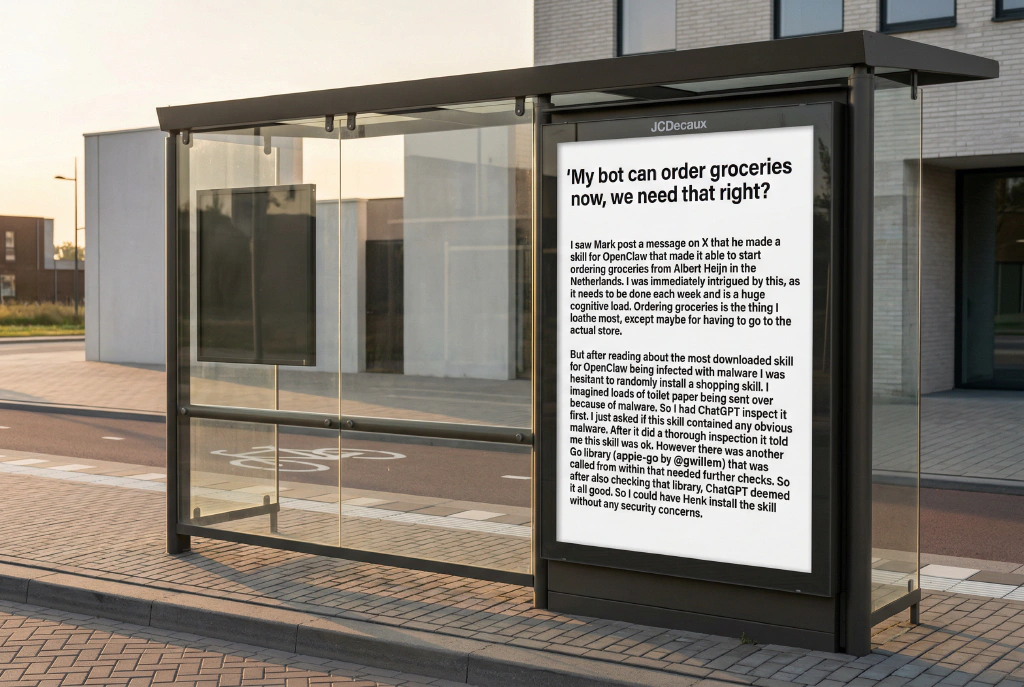
The version produced by Nano Banana 2 looked more like a real bus stop in the Netherlands. The text was reproduced perfectly, and the overall scene realism was stronger than in the Seedream-5-lite version.
Key Insight
Long-form texts can now reliably be integrated into realistic scenes. However, proper brand logos remain fragile under realism constraints. The bottleneck has shifted from typography to creative prompting and brand control.